
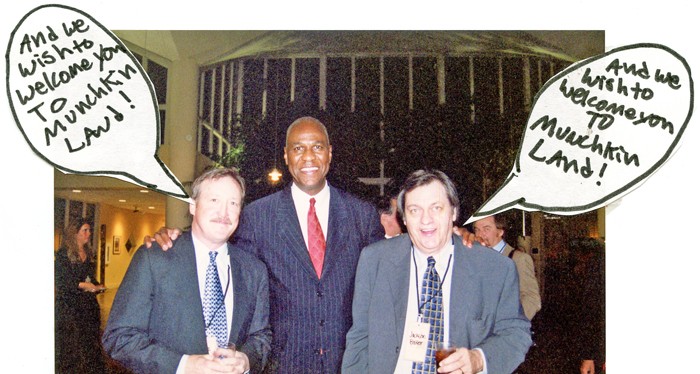
At a previous CMI commemorative event (Flyer, Memphis Magazine, whatever) editor Bruce VanWyngarden and senior editor Jackson Baker were joined by a friend. The dialogue balloons were added by some unidentified wag. This picture is preserved under glass somewhere in Flyerland.
Space in this issue doesn’t permit anything like the full compass of
what it’s been like to cover the politics of this locality, and —
many times more than tangentially — of the state and nation,
courtesy of the Memphis Flyer, for lo, these last 20
years. In fact, no space in any issue could. Frankly, I’ve had to
struggle to find some shorthand means of summing it up.
One way might be a few of the quotes that, interesting in
themselves, also signified something about the sayer and the political
context.
There was, for example, the famously irascible and self-arrogating
(and ultimately self-damning) state senator John Ford telling me
once he was “pissed off to the highest level of pisstivity” about
something or other. He always was.
Back in April 2005, writing about a trip home from Nashville to
Memphis as a passenger in the notoriously speedy senator’s Mercedes
sports coupe, I confessed to a regard for the old scofflaw, who could
work the angles for worthy causes like mental health as well as for
himself.
A month later, Ford was nabbed, along with others, in the Tennessee
Waltz sting and was irrevocably on the fast downhill slide that led to
his current long-term incarceration in a federal prison.
More fortunate was Senator Ford’s brother, longtime Memphis
congressman Harold Ford Sr., who guided the politics of
inner-city Memphis like nobody else, before or since, and in 1993 won
exoneration on a bank fraud charge in a federal courtroom from an
imported West Tennessee jury that was as white and rural as Ford
himself was urban and African American.
Ford’s long legal ordeal, which stemmed from his relationship with
the political and banking Butcher brothers of Knoxville, had meanwhile
cramped what might have been a distinguished congressional career
— though his pain was no doubt salved somewhat by witnessing the
meteoric rise to national stardom of his son and successor, Harold
Ford Jr., whose career prospects remain bright, even after his
narrow defeat in a 2006 U.S. Senate race.
The senior Ford had helped Willie Herenton win election in
1991as the city’s first elected black mayor, but the fact was, the city
— like a high-noon Main Street in the Old West — was too
small to contain amicably two such looming presences, and there came
the inevitable clash, the pretext of which was a quarrel over who
should fund a 1994 summer jobs program and for how much.
So intense was the dispute over a telephone line that, as ex-boxing
champion Herenton would tell me later, “If he’d said those things to my
face, I’d have whipped his ass.”
Quotes, I was saying. Probably none in my experience can top the
immediate impact of one which the long-term mayor gave me just this
past summer, as, having surveyed his mayoral career up to the moment,
he began looking forward to the race for Congress which, his current
legal jeopardy permitting, he projects having against the current
congressman from Memphis’ 9th District, Steve Cohen.
“I’ve known Cohen for over 30 years,” Herenton said. “And to be
honest with you, he’s an asshole. Anybody who knows Cohen knows he’s an
asshole.”
Wow. Anything you want to say about all this anal imagery, Dr.
Freud?
Cohen, too, is a wordsmith par excellence, but the action of his
that has most impressed me came when, polio-crippled leg and all, he
physically muscled out of a press conference at his home an
Armenian-American ideologue who was twice his bulk and half his years
and who had been stalking Cohen for months to punish him for voting
against a congressional resolution charging Turkey, a de facto American
ally, with a century-old genocide.
Spunky dude, that Cohen, who went on that year of 2006 to win
reelection by something like a 4-1 margin in the predominantly
African-American 9th District.
Other moments of consequence:
• Watching the meteoric political rise of my old Washington,
D.C., workmate, Blanche Lambert of Helena, Arkansas, a receptionist
with U.S. representative Bill Alexander when I was the
congressman’s press secretary and speechwriter.
She beat our ex-boss to get started in 1992, and I saw it coming. We
put the neophyte candidate on the cover of the Flyer and made
her a heroine of what we (“we” being mainly then editor Tim
Sampson) chose to call “The Year of the Woman.”
More recently, U.S. senator Blanche Lambert Lincoln has
become the bête noire of progressive Democrats who see her as too
conservative for their tastes.
• Flying around the U.S.A. with two presidential candidates
(Tennessee’s own Lamar Alexander in 1995 and Howard Dean
in 2003) and covering every political convention of both national
parties since the Flyer began sending me in 1992. (I had started
the habit, more or less on my own, in 1984 and 1988, the latter year
writing up the story for our stable-mate publication, Memphis
magazine.)
• Ditto with the New Hampshire primaries and, beginning in
2000, the Iowa caucuses. Particularly rewarding was the 1992 campaign
year, when I was able to follow the national emergence of Bill
Clinton all the way to election night in Little Rock and his
inauguration two months later.
Clinton. Gore. Thompson. Sund-quist.
Alexander. Corker. There are stories — some of them
known, some of them not — connected with all of these and with
myriad others unnamed here. The movers. The shakers. The dealmakers.
The rascals. The raconteurs. The backroom skulkers.
Okay, okay, so there’s a book to write. Anything less —
including this column and my other one contributed to this now happily
august publication’s 20th anniversary issue — is merely
scratching the surface.
No Decision Yet in Contest for Interim County Mayor
Really, it lasted less than five hours from beginning to end, but
Monday’s meeting of the Shelby County Commission — the core of
which was an effort to name an interim county mayor to serve until the
general election next August — had the feel of a marathon.
The wear and tear was such that even the two commissioners —
acting chairman Sidney Chism and Henri Brooks — who
had vowed midway to continue all night if necessary to get a winner,
were content by late afternoon to accept a postponement until a special
meeting on Tuesday, November 17th, when those members of the commission
eligible to vote will try again.
Though Commissioner George Flinn and county CAO Jim
Huntzicker (both briefly) and erstwhile commission chair and acting
mayor Joyce Avery (intermittently) were also candidates,
Monday’s session was essentially an unyielding standoff between
commissioners Joe Ford and J.W. Gibson.
Both are Democrats, though each would boast — and maintain
— support across political boundaries. Their support was indeed
perfectly balanced. Except on those few occasions when Avery or Flinn
or Huntzicker could claim a vote or two, the final tally for each of
the 24 ballots was an unvarying 5 to 5.
Ford was supported by Democrats Matt Kuhn, Steve
Mulroy, and Chism and by Republicans Mike Ritz and Wyatt
Bunker. Gibson’s backers were Democrats Deidre Malone,
James Harvey, and Brooks and Republicans Flinn and Mike
Carpenter. Not only was party not a major factor, neither was
ideology, as each support group ran the gamut from right to left.
What did figure were complex personal relationships (both pro and
con), paybacks for previous alliances, patently opportunistic
calculations on the part of some commissioners, and suchlike. The only
time the standoff became heated was when Huntzicker was nominated by
Malone as an expedient to break the impasse.
Between now and next week, other third-party names will be
considered, and the partisans of Ford and Gibson (and mayhap of Avery
and Flinn as well) will sound out their colleagues on such deals
(Sunshine Law or no Sunshine Law) as may break the tie and produce a
winner.
