
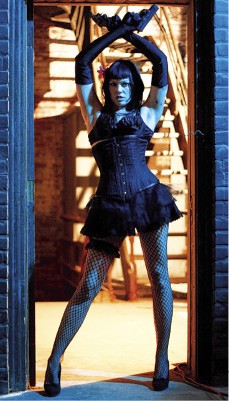
 Don perry
Cori Dials
“All you need to make a movie is a girl and a gun.”
— Jean-Luc Godard
A pioneer of ’60s New Wave cinema, Godard was making a case with
this famous quote for the ability of image and attitude to triumph over
limited means, an idea that fits the cultural thrust of Memphis art in
most any medium.
The first feature in nearly a decade from local filmmaking pioneer
John Michael McCarthy, Cigarette Girl takes the quote to heart.
The low-budget dystopian noir stars Amazonian wonder Cori Dials in the
title role, a black-market cigarette dealer who quits smoking and
defies her mob employers, forcing her to simultaneously fight against
nicotine withdrawal and for her life. The film’s tagline: “She’d kill
for a smoke.”
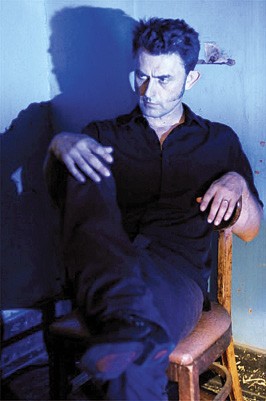 robin tucker
Mike McCarthy
Cigarette Girl is a different kind of film for Mississippi
native McCarthy, a comic book artist turned filmmaker who built a
worldwide underground reputation in the ’90s as a purveyor of ’50s- and
’60s-style “exploitation cinema,” displaying the natural talents of
muse D’Lana Tunnell in films such as the (mostly) black-and-while
Teenage Tupelo (a curious, memorable blend of Elvis lore,
personal fetish, and mixed-up autobiography) and the lurid color The
Sore Losers (a genre-hopping, comic-book-crazy thriller starring
garage-rocker Jack Yarber). This stretch of films culminated in 2000’s
visually striking girls-with-guns Superstarlet A.D., a
woman-worshipping spectacular that was something like Russ Meyer
(Faster, Pussycat! Kill! Kill!) gone glam-rock.
McCarthy’s new film, by contrast, cuts back on spectacle while
beefing up story. It also draws on a slightly different mix of cultural
influences: girlie mags, trash cinema, and early rock-and-roll giving
way to anti-hero comics, film noir, and gritty sci-fi. (Fritz Lang’s
silent classic Metropolis is repeatedly referenced.)
The film is set in 2035, a future in which cigarette smokers have
been ostracized into crumbling ghettos dubbed “smoking sections” and a
pack of cigarettes costs more than $60. Dials’ character works as a
cigarette girl in the mob-controlled, smoking-section hangout the Vice
Club, but she is undercutting her employer by dealing packs on the
street for $50. Early in the film, her bosses discover her
double-dealing as she discovers her cigarette-addicted grandmother
(local film vet Helen Bowman, in perhaps her best role) dying of
emphysema. Among the other cast members are slender, tomboyish punkette
Ivy McLemore (a recent McCarthy discovery who later landed a role in
the MTV web series Savage County) as the replacement cigarette
girl, J. Lazarus as a menacing mid-level heavy, and D’Army Bailey as a
smoking-section quickie-mart owner.
Everything in Cigarette Girl orbits around Dials, though.
McCarthy demands a lot from her in what might be considered something
of a superhero origin story. She is asked to be an iconic presence, and
she delivers. Dials is a spectacle even when not stripped down to bra,
panties, and fishnets. (Unlike most of McCarthy’s other films,
Cigarette Girl contains no full nudity.) Her palpable
combination of toughness and vulnerability makes her character
click.
“Cori is like the living, breathing embodiment of what a cult movie
becomes by sitting on a shelf for 25 years,” McCarthy said last week in
the attic of his Cooper-Young home, which might double as museum of his
work and its influences. “I didn’t have a million dollars, but she
looks like a million dollars. I haven’t made a movie in 10 years [in
part] because I hadn’t met anyone like Cori in that period of
time.”
An attraction to Dials as an authentic presence, and a desire to
capture that presence on film, was as much an impetus for Cigarette
Girl as anything. McCarthy was similarly inspired in some of his
early films by Tunnell, whose gold-framed black-and-white nude photo he
references to explain Dials’ appeal.
“If you look at that picture of D’Lana, that could be 1930. It could
be 1950. It could be 1970,” McCarthy says. “It’s a motorcycle junkyard
in Mississippi in 1992. If I have any gift at all — whether the
movie is uneven or incoherent or beautiful or has good moments or bad
moments — the gift I have is objectifying that, because I drew it
first when I was doing comics, and I can still see it when I’m making
films.
“The beauty of [Dials] is very much like D’Lana there. She’s not an
actress. She’s a starlet,” McCarthy says, deploying a pet word that’s
been used in the title of two of his films. “Anybody can act. But only
certain people that nature spits up can be starlets. They have a
charisma.”
McCarthy met Dials while working as a tour guide at Sun Studio and
later partnered with her in the glam-rock band Fingers Like Saturn
before Dials moved to Virginia, where she’s now training to be a
mortician.
“Cori sings like a pop-culture priestess and looks like a
gothic Brigitte Bardot,” McCarthy says. “So she has all these inherent
pop-culture qualities to her. She has to move around a lot. She gets
heckled. Can you imagine walking around on the street and looking like
God?”
While not at all rejecting the “exploitation” moniker, McCarthy
talks about the women he films in terms of “female empowerment,” citing
social critic Camille Paglia. He describes Cigarette Girl as a
film “about a female character who uses a sexual persona to survive in
a dystopian world where men are in control.” He also says that he casts
women to play himself, an assertion most detectable in Teenage
Tupelo and Cigarette Girl. (McCarthy’s own mother died of a
smoking-related illness.)
“I seem to be the only local filmmaker who has decided to do fantasy
— epic fantasy — on a shoestring,” McCarthy says of his
place in a growing local film scene that he, perhaps more than anyone,
helped launch. (In a Flyer interview last year, Craig Brewer
described himself as “very much a student of Mike McCarthy.”)
McCarthy hopes that more people will join him in the fantasy with
Cigarette Girl, though one also has to wonder if all of
McCarthy’s hardy cult will be as enamored of this more professional
film with less camp and sensationalism.
“The other stuff is my street cred,” McCarthy says. “This borrows
from that but is a little more commercial, a little more formula.”
After a world premiere this summer at the Perth Revelation
International Film Festival in Australia, Cigarette Girl will
have its U.S. premiere this week at Studio on the Square in a pair of
screenings co-sponsored by the Indie Memphis Film Festival and the On
Location: Memphis International Film Festival, a collaborative first
for the two local festivals.
“You know, I predate the festivals,” McCarthy says. “I haven’t had a
lot of stuff play the festivals because I haven’t been prolific this
decade. But they’ve both been very good to me, and I couldn’t just give
the movie to one festival over the other. I wanted them to come
together and share it with me.”
Cigarette Girl Premiere
Studio on the Square
Thursday, September 10th
7 and 7:30 p.m.; $12
Premiere tickets include admission to a 9 p.m. after party at Nocturnal (1588 Madison). There will also be midnight screenings at Studio on the Square the following Friday and Saturday nights. See the film’s official web site for more info on screenings and related events. For more on Mike McCarthy and Cigarette Girl see the Flyer’s pop culture blog, Sing All Kinds.
