
 jackson baker
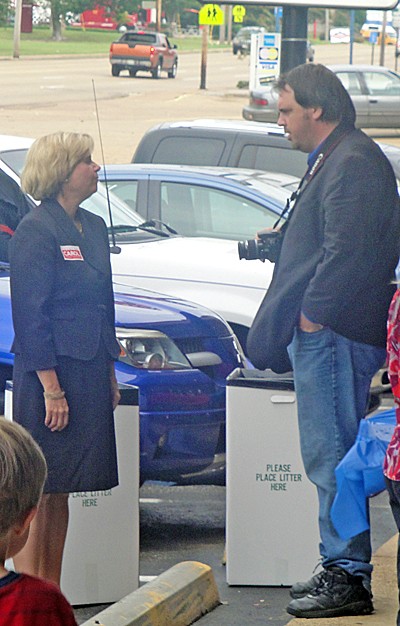
Carol Chumney with campaign aide Rick Maynard
By virtue of their high-profile public positions, Shelby County
mayor
A C Wharton and Memphis mayor pro tem Myron Lowery
have been able to dominate much of the news of the ongoing mayoral
campaign. But, with a month to go, others — like former City
Council member Carol Chumney — are sure to be heard
from.
Like her campaign in general this year, Chumney’s
headquarters-opening event on Saturday started slowly. Part of the
problem may have been the overcast weather or a competitive event.
(County Commission candidate Norma Lester drew a generous crowd
of Chumney’s fellow Democrats for an indoor fund-raiser at the MLK
Center on Beale downtown.)
Ultimately, Chumney gathered a decent crowd and decided to warm up
the crowd for the band rather than vice versa. The result was certainly
one of her best speeches of this year’s campaign, rivaling anything she
did on her first run for city mayor in 2007, when she finished a
reasonably close second to incumbent Willie Herenton in a
multi-candidate race.
Wharton, who is considered the front-runner in this year’s special
mayoral election, may not be as easy a target as Willie Herenton
was two years ago, but Chumney honed in on him just the same, charging
that Wharton was “jumping ship” and running for city mayor before he’d
figured out what to do as county mayor.
She cited what she said were problems at the Med so dire that the
hallowed institution servicing Memphis’ poor might have to close its
doors, and she ridiculed what she characterized as a “40-point plan” by
Wharton that would bring “new layers of bureaucracy to city
government.”
As for herself, she promised to fine-tune the city’s police force
and to give special attention to developing vacant properties, both at
the neighborhood level and at the Pyramid and fairgrounds. She reminded
her audience that she had accomplished some things as a former
legislator and council member, notably in the area of improving
standards for child care.
All in all, it was an energized appearance, helped no doubt by her
decision to elevate Rick Maynard, a former campaign aide to 9th
District congressman Steve Cohen, to the position of campaign
manager or coordinator.
• Another mayoral candidate sure to be heard from further is
lawyer Charles Carpenter, who seems to have ground troops and
something of a budget. One of Carpenter’s proposals — to raze the
Pyramid and start over with North End development — is indicative
of Carpenter’s intent (and need) to break out of the pack of
challengers, as well as away from his longtime identification as a
Herenton partner and ally.
On that point, Carpenter was at pains recently to correct what he
said was a frequent misstatement in the media — that he had run
all of Herenton’s five mayoral campaigns. He was involved in only
three, he maintains — the initial Herenton run of 1991 and those
of 2003 and 2007. Wharton, who bore the title of campaign chairman, ran
the other two, in 1995 and 1999, Carpenter said.
• There was a changing of the guard at the Shelby County
Commission on Monday — and a changing of commissioners’ pay
grade, as well.
Joyce Avery, a second-term Republican from Arlington, assumed
the chairmanship from outgoing chair Deidre Malone, a Democrat,
and so felicitous was the transition that one could almost forget the
modest acrimony that may have lingered from Malone’s failed attempt
back in July to get herself elected to a second consecutive term as
chairman.
There were no notable apostasies on Monday. The commission voted
12-1 for a controversial 5 percent pay reduction in commissoners’ pay,
from $30,000 annually to $28,500.
Not that the feeling was unanimous. Irate Democrat Sidney
Chism denounced it all as “showboating,” and several other
commissioners expressed reservations, Malone confessing she was “not
sure it’s the right thing to do,” and both Steve Mulroy and
fellow Democrat Matt Kuhn expressing concern that the vote might
contribute to the devaluing of the public sector. And Democrat Henri
Brooks renewed her appeal of last Wednesday’s committee session for
the idea of “restructuring” the commission, making its positions
full-time and compensating them in kind.
But in the end only Chism cast a vote against the commissioners’ pay
cuts. The others either acquiesced in the majority sentiment or, like
Republican commissioner George Flinn, continued to see the
self-abnegation as “leadership” in a time of general economic woe.
The commission’s unanimity broke down somewhat on a subsequent vote
to apply an equivalent 5 percent pay cut to the salaries of the sheriff
and county mayor, with five commissioners — Democrats Kuhn and
Mulroy and Republicans Mike Carpenter, Mike Ritz, and
Avery voting to restore Sheriff Mark Luttrell to his current
salary of almost $118,000. The majority was willing to see the
sheriff’s position reduced by the same proportion as the
commissioners’, to $115,000.
• U.S. representative Cohen has been no slouch at garnering
national publicity since his first election in 2006. The congressman
has appeared on various TV shows, has figured in numerous interviews by
Capitol Hill journalists, and has made more than his share of news,
most notably in the worldwide coverage of his sponsorship last year of
a congressional resolution apologizing for slavery.
Cohen figured prominently twice this week in The New York
Times, and whether these two mentions accrue to positive or
negative outcomes is something for time, and not the Times, to
unravel.
The first mention was in Sunday’s edition of The New York Times
Magazine, in James Straub‘s article “The New Israel Lobby,”
which deals with the emergence of J Street, a progressive Jewish lobby,
which, among other things, aims at a more even-handed approach to
Middle Eastern questions, especially the Israeli-Palestinian standoff,
than traditional organizations like AIPAC (American Israel Public
Affairs Committee).
Cohen figures in the article as a representative Jewish congressman
drawn to J Street’s positions. A paragraph reads:
“Even J Street’s staunch friends on the Hill acknowledge the
potential costs of their position. Steve Cohen, a Democratic
congressman who represents Memphis, told me that in his mind Israel had
squandered its heroic status through its wars in Lebanon and Gaza and
had come to be seen as ‘the neighborhood bully.’ But he recalled that
‘when J Street first surfaced, the talk among members was, “Do we get
near them?”‘ The organization had endorsed Cohen and asked if he would
record a video for its Web site. ‘Several veteran Jewish members
cautioned me not to do it,’ he said. ‘They were afraid I would be
attacked by AIPAC. Some people whispered about the possibility of
having an opponent.’ He went ahead and made the video. He also signed
the J Street letter calling for deeper American engagement in the peace
process. I asked if there had been any repercussions. ‘I’m thinking
about it,’ said Cohen, a significantly wryer-than-average legislator.
‘I did have some strong AIPAC supporters who didn’t come to my last
fund-raising party. And they’re normally the first people to come
forward.'”
Though “the New Israel Lobby” is generally sympathetic to J Street,
the section on Cohen, like the article as a whole, stresses the
possible political dangers of breaking with AIPAC and other established
pro-Israel lobbies.
Monday, a day later, would see the appearance of a Times
article by reporter Robby Brown, who spent several days in
Memphis recently interviewing various people about next year’s pending
Democratic primary showdown between incumbent congressman Cohen and
former Mayor Herenton, who has indicated he will oppose Cohen.
Brown’s article makes the usual stops, alluding to Cohen’s easy go
of it against African-American opponent Nikki Tinker in 2008,
his efforts to attend to the interests of the disproportionately black
constituency of the 9th District, Herenton’s oft-quoted “Cohen is an
asshole” remark to the Flyer, and the ex-mayor’s essential
challenge, summed up in Herenton’s analysis of the contest: “It’s going
to be about race, representation, and power.”
A representative quote comes from the Rev. Ralph White,
pastor of Bloomfield Baptist Church who has been a vocal supporter of
Cohen: “There are those who come up to me and say, ‘Even though I love
Steve, this is a very important seat to the African-American
community.’ It’s a very sticky, touchy situation.”
